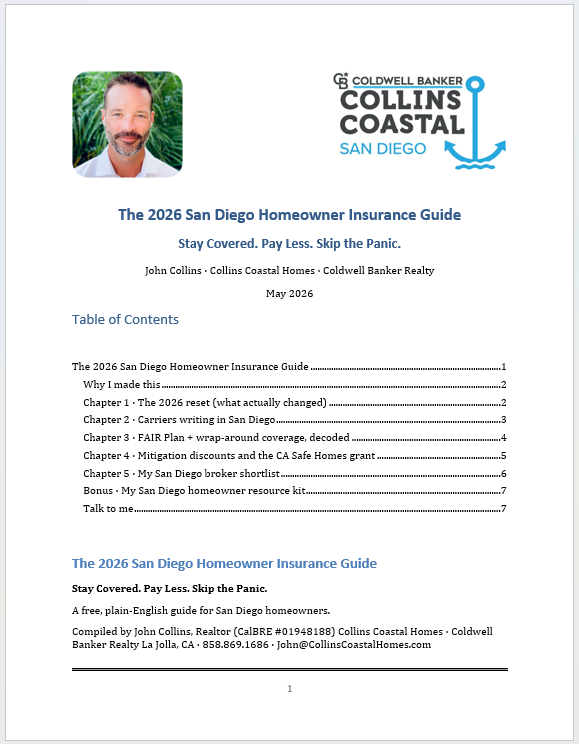
2026 San Diego Home Owner Insurance Guide
Stay Covered. Pay Less. Skip the Panic.
San Diego homeowners are facing a very different insurance market in 2026. This free guide explains what changed, how to shop smarter, when the FAIR Plan makes sense, and what mitigation steps may help lower your premium or improve your coverage options.
Enter your name and email to download the free guide.
Why San Diego Homeowners Need This Guide
Home insurance in California has changed fast. Premiums are higher, underwriting is tighter, and some homeowners are learning at renewal that their options are more limited than they expected.
This guide was created to help San Diego homeowners understand what is actually happening, what to ask their insurance broker, and how to avoid common coverage mistakes.
Inside, you’ll find practical guidance on:
- What changed in California’s insurance market in 2026
- Which types of carriers may still be writing in San Diego
- How to use the California Department of Insurance Home Insurance Finder
- What the FAIR Plan does and does not cover
- Why many homeowners need DIC or wrap-around coverage
- Mitigation steps that may help with eligibility or discounts
- The new California Safe Homes grant program
- A short list of trusted San Diego insurance contacts
- Helpful homeowner resources to bookmark
What’s Inside the 2026 San Diego Homeowner Insurance Guide?
1. The 2026 California Insurance Reset
California’s insurance rules changed in a big way. The guide explains the Sustainable Insurance Strategy, new wildfire-related rules, and several 2026 laws that may affect homeowners.
You’ll get a simple explanation of what these changes mean for homeowners, especially those in harder-to-insure areas.
2. How to Find Carriers Writing in San Diego
Carrier appetite changes often, so the guide does not rely on a stale list of insurance companies. Instead, it shows homeowners how to check current availability using public tools and how to talk with an independent broker.
You’ll learn the difference between carriers that are:
- Writing new policies
- Renewing existing policies
- Offering surplus lines or non-admitted coverage
This is especially useful if you are buying, selling, refinancing, or preparing for renewal.
Instagram Video: Watch this before calling your insurance company about a claim
3. FAIR Plan and Wrap-Around Coverage Explained
The California FAIR Plan can be a safety net, but it is not the same as a standard homeowners policy. The guide explains what the FAIR Plan usually covers, what it often leaves out, and why many homeowners pair it with a Difference in Conditions policy.
The guide also covers four common FAIR Plan mistakes, including mismatched dwelling limits, missing DIC coverage, outdated replacement cost estimates, and lender paperwork issues.
4. Mitigation Discounts and the CA Safe Homes Grant
Some homeowners may qualify for insurance discounts by documenting fire-hardening improvements and defensible space work.
The guide includes a practical mitigation checklist covering items like:
- Class A fire-rated roofing
- Ember-resistant vents
- Zone Zero defensible space
- Enclosed eaves and soffits
- Double-pane tempered windows
- Photo documentation for insurance files
It also explains the new California Safe Homes Act grant, which may help eligible homeowners pay for certain fire-hardening improvements.
Who This Guide Is For
This free guide is especially helpful if you are:
- Preparing for your home insurance renewal
- Worried about a non-renewal notice
- Buying a home in San Diego
- Selling a home in a higher-risk area
- Trying to understand the FAIR Plan
- Comparing quotes from different insurance brokers
- Wondering whether mitigation upgrades are worth it
- Looking for trusted local insurance contacts
Whether you own a coastal condo, a Pacific Beach home, a La Jolla property, or a house near a canyon or wildfire interface area, this guide will help you ask better questions before making insurance decisions.
[Download the 2026 Guide]
Why I Created This Resource
I’m a real estate agent, not an insurance broker. But insurance touches almost every real estate conversation right now.
In 2025, the questions I heard from clients changed. It was no longer just, “What’s the rate?” It became, “Is anyone still writing policies?”
So I pulled this guide together after reviewing public resources, California insurance updates, and conversations with local insurance professionals. My goal is simple: help San Diego homeowners feel more prepared and less reactive.
This guide is educational, not insurance, legal, or tax advice. Always speak with a licensed insurance professional about your specific property and policy.
FAQs About San Diego Home Insurance in 2026
Why is home insurance getting harder to find in San Diego?
California’s insurance market has been under pressure from wildfire risk, rising replacement costs, reinsurance costs, and changing carrier appetite. In San Diego, even homes with lower wildfire exposure may face higher premiums because of rebuild costs, coastal exposure, or underwriting changes.
What is the California FAIR Plan?
The FAIR Plan is California’s insurer of last resort. It can provide fire coverage when traditional carriers will not write a policy, but it is usually narrower than a standard homeowners policy. Many homeowners need additional wrap-around coverage to fill important gaps.
Does the FAIR Plan cover liability or water damage?
Typically, the FAIR Plan does not provide the same broad coverage as a standard homeowners policy. Liability, theft, vandalism, water damage, and loss of use may be limited or excluded, which is why many homeowners pair it with a Difference in Conditions policy.
Can fire mitigation improvements lower my insurance premium?
They may. California insurers that use wildfire risk in pricing are required to account for certain mitigation measures. Discounts vary by carrier, but improvements like ember-resistant vents, defensible space, Class A roofing, and documentation may help.
What is Zone Zero?
Zone Zero generally refers to the first five feet around your home. Keeping this area clear of combustible materials can reduce wildfire risk and may help support insurance eligibility or mitigation discounts.
Is this guide only for homes in wildfire areas?
No. The guide is useful for San Diego homeowners across coastal, inland, and canyon-adjacent neighborhoods. Even if wildfire risk is not your biggest issue, rising replacement costs and changing underwriting standards can still affect your coverage.

Address
888 Prospect St. Suite 140 La Jolla CA 92037
Coldwell Banker Realty, CalBRE# 00616212



Interested in Pacific Beach property, specifically? Check out PacificBeach.RealEstate
This information is deemed reliable but not guaranteed. You should rely on this information only to decide whether or not to further investigate a particular property. BEFORE MAKING ANY OTHER DECISION, YOU SHOULD PERSONALLY INVESTIGATE THE FACTS (e.g. square footage and lot size) with the assistance of an appropriate professional. You may use this information only to identify properties you may be interested in investigating further. All uses except for personal, non-commercial use in accordance with the foregoing purpose are prohibited. Redistribution or copying of this information, any photographs or video tours is strictly prohibited. This information is derived from the Internet Data Exchange (IDX) service provided by Sandicor®. Displayed property listings may be held by a brokerage firm other than the broker and/or agent responsible for this display. The information and any photographs and video tours and the compilation from which they are derived is protected by copyright. © 2020 SDMLS ~ By contacting John Collins / Collins Coastal, you agree to receive customer service texts from this business. We will not send you messages without your consent and we will not sell your data. Providing your contact information is confirmation you agree to receive text messages and/or calls from John Collins / Collins Coastal, your phone provider may have fees for this service. Message frequency varies. You may reply STOP at any time to cancel or call us at 858.252.0200.
Powered By: